I copied a rock solid signal from J38DX this morning on 20 meters. Despite an hour of trying to work what would be an ATNO, I came away empty. According to his QRZ info, Eric, GM5RDX will be on the island until Sunday, July 13th. So there should be a few more chances to snag this one. You’d think Grenada would be a chip shot from here, but there was nothing doing today.
Lovely Day
Wednesday morning was a gift. I awoke to 60F with much lower humidity and hurried outside for a long walk while it was so nice. But not before opening all the windows to get some of this wonderful cool into the house after a solid month of being hermetically sealed away from the oppressive heat and humidity. By noon the temperature was rising rapidly so I closed the place back up and once again cranked up the air conditioning. I sure appreciated that lovely break…
As expected, LoTW came back up yesterday and seemed to buckle a little as the day wore on. You gotta figure there must have been a motherlode of Field Day contact confirmations hitting the server all at the same time. Looks like it’s still catching up with the incoming flood of server requests.
I did spend an hour in the shack and made a few contacts. One of them with KD6XU who was calling CQ POTA on 20. Copy was light, practically ESP levels. After kicking in the APF (CW audio peaking filter ) on the K4 and with a little tweaking I was able to make solid contact with Barry who was operating from the San Diego Bay National Wildlife Refuge (US-0209). Though our contact was brief, I followed up on his QRZ page where I saw he is a sailor, an ocean going fellow who sails the South Pacific for fun. I even watched a couple of his YouTube videos capturing his adventures at sea.
Once the sun went down the backyard was the place to be. The fireflies put on a proper show which was a little unusual because I don’t recall having seen so many of them in recent years. I also noticed the flowers and the lawn looked especially beautiful, the fireflies added magic to all this was the perfect end of what was an incredibly lovely day. Maybe I haven’t been paying close enough attention to these simple yet wonderful perks of life on this amazing planet?
Grindstone
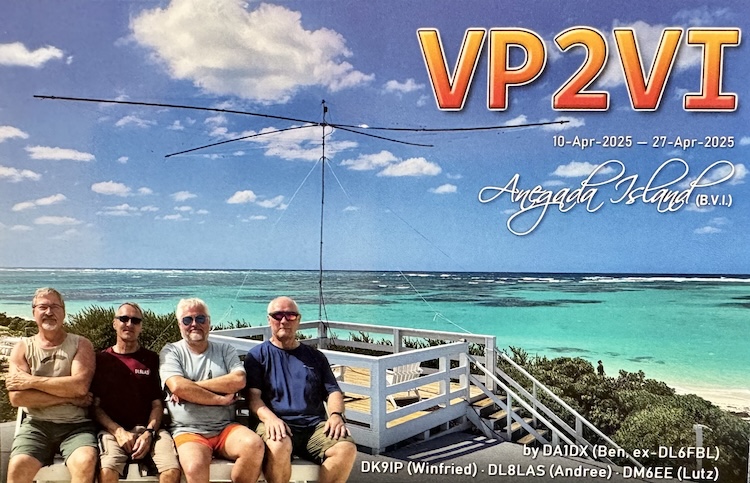
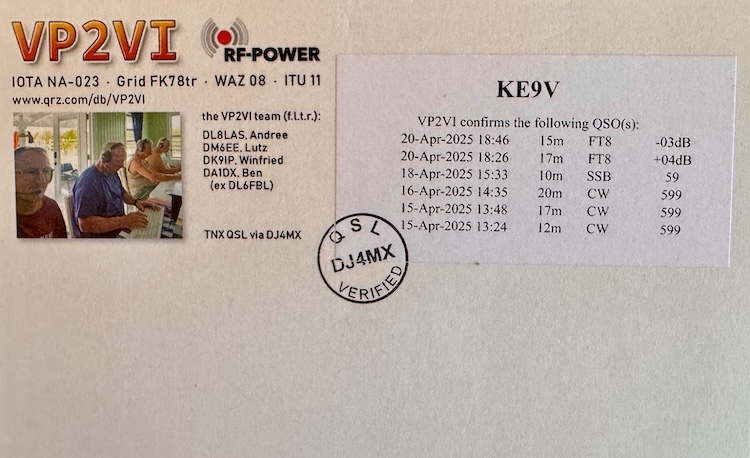
Added two more WWA stations yesterday. Making twenty-five WWA contacts this week a stretch goal. I did snag a couple more POTA stations along the way. Later in the day I added A71AT and Z33Z to the log too. Then there were a handful of 13 Colonies stations. Oh, I almost forgot, I also made a couple of contacts on 6 meters (NY1E in Maine and K4PTD in South Carolina) when I checked the band around lunch time and heard some activity. Now I’ve got a growing bunch of records to upload when LoTW comes back online and many others do too so the new system will immediately be in for a proper stress test. The digital confirmation process being down didn’t prevent my postal mail lady from dropping this actual QSL card in my mailbox today.
Turning the Calendar
The search for needed DX was a bust last night so I decided to pick off a handful of WWA stations. Seven contacts on two bands is good for 14 points. So far. I’d like to log at least twenty-five of them. This one will be a short run since the summer event only lasts a week while the winter version ran the entire month of January. I caught a note that Roger Smallwood, N8EKG became a silent key over the weekend. He was the President of Operations at R&L Electronics, a popular and longtime ham radio dealer in Hamilton, Ohio.
End of Month
We’ve arrived at the end of another month. Half the year has passed. If you consider the 4th of July as being halfway through the summer season, don’t blink, that’s coming up fast. I got back on the paddle this morning. Called CQ on 20 and 30 meters without getting a reply so I started looking for a few POTA stations. Snagged three of them, two on 40 and one on 20 meters. Will be on DX patrol later this evening. Band conditions are a little better, SSN:151 SFI:128 A:8 K:2 - but this perpetual pop-up thunderstorm season is keeping things noisy and I’m unhooking the cables whenever I leave the shack. Tired of that. C’mon autumn!
Field Day 2025
Well that was… different. CW for all occasions is typical at KE9V, so I sometimes use Field Day as an excuse to do phone. That’s how this year started, but just five contacts in I got bored and switched to digital. I was operating 1D from home, 100 watts, from the mains. I’ve never used the FT modes during this event. It was a first for me and I didn’t hate it once I figured out how to put the WSJT software into Field Day mode. I ended up putting fifty in the log in this configuration over a couple of hours when I decided to call it quits.
It's not the heat, it's the insanity
It’s been about a month since the windows have been opened. Hot and stuffy weather spent in retreat in the air conditioning does not make for a happy season. I think the brutal heatwave has passed, the high today is supposed to be 85F so the air conditioner will continue it’s work. No windows open today. But perhaps a little relief for those taking part in Field Day activities? I’ve made no specific plans, but normally do a little battery-powered QRP from the backyard. I’d be happy with 25 contacts. That would mean another year of participation plus I’ve been off the air the entire month of June. Back in the saddle again? Maybe.
Should Have Been Tweets
Field Day Weekend is upon us. Have fun. Be safe. And remember, it’s not a contest, but keep score anyway. Wink-Wink.
The motto of this year’s HAM RADIO in Friedrichshafen, “REMOTE RADIO - CONNECTING THE WORLD”, demonstrates in a unique way that amateur radio is on the pulse of the times. June 27-29.
LoTW will be shutdown today for upgrades.
The 13 Colonies Special Event runs from the 1st of July through to the 7th. Certificates are available at all levels of achievement. SWL and hunters outside the US are welcome. Operators will be using all modes on all HF bands except for 60 meters. Be listening as well on 2 and 6 meters.
Current Bouvet Island weather conditions - 21F and windy with 2-4 inches of snow expected over the weekend. Perhaps a donation for the 2026 3Y0K operation?
NEW: HackRF Pro from Great Scott Gadgets is a Software Defined Radio peripheral capable of transmission or reception of radio signals from 100 kHz to 6 GHz.
Tuvalu T2 gets even scarcer as nearly one-third of citizens in that Pacific nation seek a landmark climate visa to live in Australia as rising seas threaten their palm-fringed shores.
QSLs, LoTW, and AI
“Blogs are newsletters that don’t require subscriptions…”
There is a trend toward sending electronic QSL cards that seems to be driving a lot of hams batty, especially among the DX community. These are the result of software that makes sending an electronic image of a QSL card as easy as clicking a button. One particular vendor is responsible for most of those I’ve received and their service comes in the guise of providing you a map of all your QSOs. All you have to do is upload the ADIF from your logging program and presto you get a pretty QSO map! One more mouse click and the service will be happy to email QSL cards to all those you have contacted.
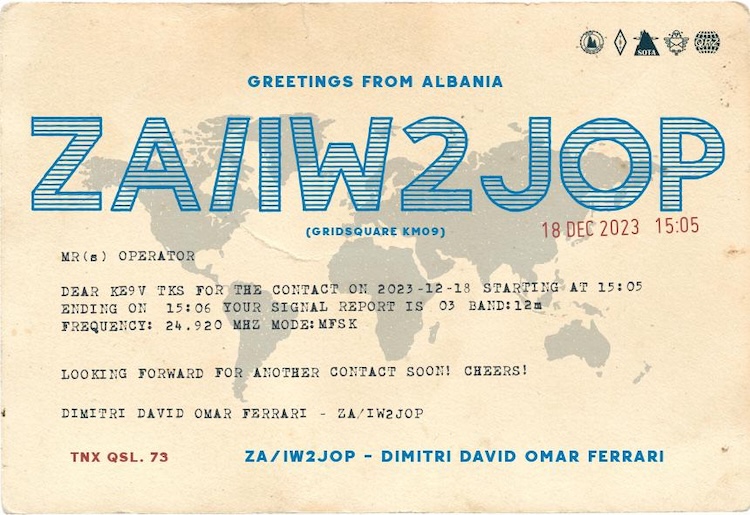
It’s easy to see why many consider this obtrusive. The email addresses are probably harvested from QRZ.com (?) causing some to consider it spam. Personally, I don’t mind getting them as they are easily deleted and I see it as a friendly gesture. I mean, it’s not as nice as an actual printed QSL card that arrives by postal mail. And unless it’s accompanied by an LoTW confirmation it’s worthless for ARRL award credit. I don’t participate in this practice, but do I despise receiving them as many seem to? Meh. Que Sera, Sera.
The coming upgrade to LoTW is long overdue and is probably a “lesson learned” from the Great Hack of 2024. I’m no IT professional, just a retired old white dude who uses LoTW exclusively on a daily basis. Since any and all improvements are in my own self-interest, what I say here may just be the bleating of an old goat. But I believe it’s time for all users of LoTW to get behind this effort and make a donation to support the cause. Yeah, it’s a free service. For now. But I’ve uploaded more than 15,000 QSL records to LoTW and had that been QSL cards via postal mail it would come to a staggering sum of money. I’m not saying the two are equal, but this is the game we play and this is the service that makes it possible. Only a cheapskate would use LoTW and not be willing to toss them a few bucks.
Surely there are no freeloaders among the noble amateur radio fraternity?
I’m old, retired, and don’t have to pay attention to all the AI falderal. Honestly, I’m sick of hearing about it though it has become too pervasive to ignore completely. I believe it’s marketing hype driven by unrealistic hopes and expectations for endless corporate profit. It is interesting the way some see it as a replacement for human labor and maybe it is for certain tasks. Maybe.
But my wife and I were visiting another small town yesterday where we stopped at a Starbucks. It was nearly 100F as this oppressive dome of heat just won’t ease up. The ‘feels like’ temperature has been hovering around 110F. Brutal, right? So I’m sipping a latte inside the cool air-conditioned coffee shop when I noticed four guys working on the roof of a nearby gas station/convenience store. Obviously emergency A/C work given the weather at the moment. The roof was black pitch and I assume 50 degrees hotter up there than on the ground. I also assume that workers inside the station were complaining about the A/C being out in such miserable weather despite it being at least 50 degrees cooler where they were.
I asked my wife, do you suppose AI will one day put those guys out of work? Hell no. There is no AI coming that will replace them. In fact, I think they need to start asking for a thousand dollars or more an hour for what they do. Same goes for the plumber. Is AI gonna crawl under my kitchen sink and fix a leak? Hell no. Same goes for hundreds of other tasks that even Elon’s robot army won’t be capable of doing for a hundred years, if ever.
The eventual legacy of this silly AI moment should be higher labor costs for skilled work. I’m not talking about the ‘gee-whiz’ summarizing of your email messages. Or the falling cost of employing script kiddies. Certainly the cost of some software creation might go down, though the public won’t benefit from those reductions as corporations will hang on to every extra dime to offset the supernatural volumes of energy and new data centers this dystopian future demands.
I can, however, see the cost of real human labor becoming much higher than anyone ever thought possible. Imagine one day seeing woodworkers, plumbers, HVAC techs, auto mechanics, and other skilled crafts people in line with America’s oligarchs waiting to order their new yachts…
This, That, and the Other
The International DX Association recently coordinated multiple resources from around the world to help improve the only amateur radio station on Tristan da Cunha:
INDEXA does not normally support private stations. However, in this case we had the only licensed ham on a remote island entity whose population is around 250 people. ZD9 is #55 on the most wanted DXCC list (Club Log) even after some serious activity by ZD9W in 2023. In addition, we already had extraordinary support from ICOM, DX Engineering, WIMO and YASME.
NCDXF is pleased to announce an $8,000 grant to Michael, G7VJR for a hardware upgrade to Club Log:
Club Log is used by DXers and DXpeditioners all around the world. “Club Log is a free service operating at a global scale, supporting 130,000 callsigns and storing 1.25 billion QSOs. Every second of every day, a worldwide base of HF DXers rely on Club Log to enhance their enjoyment of the hobby. To many, Club Log’s features and tools and integral to their pursuit of DX. To operate at this scale, Club Log uses high-end servers of the kind you might find in a major internet company’s data centers. Paying for this has only been possible due to major foundations stepping in to give us the help needed. Our server equipment was last updated in 2019, and in the intervening time the use of data modes and our popular livestreams feature has expanded dramatically, putting higher and higher loads on our existing systems.
NASA Satellite That’s Been Dead for 57 Years Sends Mysterious Signal to Earth:
A little over a year ago, scientists in Australia picked up a brief burst of electromagnetic radiation. The pulse was so strong that it eclipsed all other signals coming from the sky, but its origins were unknown. After digging through the data, the team discovered that the source wasn’t a distant celestial object but rather a zombie satellite left to orbit Earth with no purpose.